

Sacrifice: Is It Real, or Just a Fraud?
The word sacrifice is thrown around like an unearned badge of honor. It is used to convince the world that someone suffered so much for where they are—or that you owe them an eternal debt.
The entrepreneur “sacrificed” for his business.
The athlete “sacrificed” for the medal.
The doctor “sacrificed” for her career.
The parent “sacrificed” for their child.
Be honest. Was it really a sacrifice? Or was it simply the sticker price of the path they chose?
You actively or passively choose something, and when you had to pay the cost, you call it “sacrifice”, so you can reap benefits by either manipulating others or building a pure, selfless image for yourself. It is a subtle way of pretending you were forced into the life you begged to live.
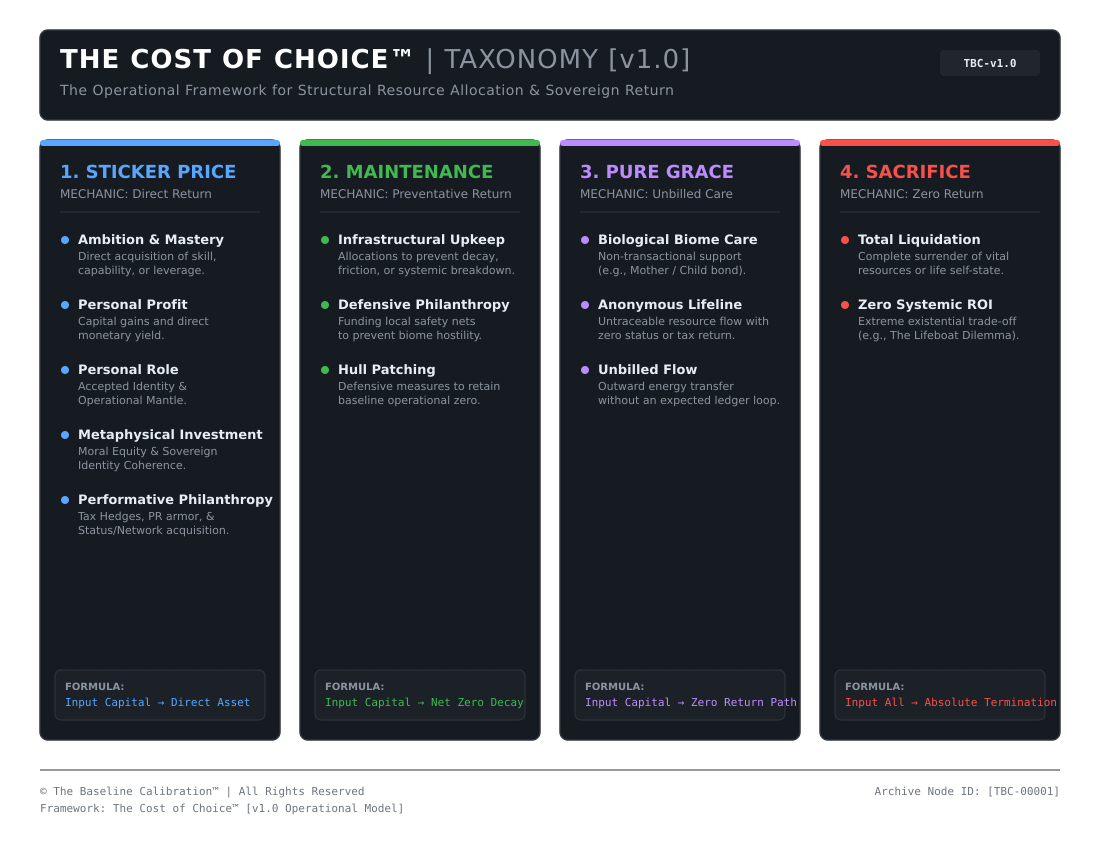
1. The Sticker Price (Individual Return)
When you buy a lottery ticket, you pay the price for the right to enter. For winning a jackpot, there are many variables in play. For winning a jackpot in life, capital, connection, knowledge, opportunities, everything matters.
When a young athlete spends ten years training, eating clean, and missing parties, they haven’t “sacrificed.” They have simply paid the non-refundable sticker price required to enter the arena. The national team only has 11 seats, not a million. When you pay the cost of your choice, you are granted admission. But a system has a limit. So only a limited number will be selected. And we can’t assume that they were the best in their field, but rather that the combination of their different variables proved to be the most effective.
If the rent on an apartment is too high, a rational tenant doesn’t pay it and then cry “sacrifice” to the landlord. They either pay the rent or move to a smaller room.
The universe does not owe you a favor for paying the cost of your own ambition. In a way, you are dishonouring your sovereignty of choice. Know what it will cost, what you will get, what the system limit is, what the odds are, account for the existence of unforeseen variable and events and then decide. After you have decided, whatever the outcome is, accept it gracefully. That is the honorable way to respect your sovereignty. Remember, some costs of your choice will be paid directly by you and some would be borne by the ones in your perimeter. So account for them too; if you can’t, you had better live an individualistic life. Don’t drag others into your mess.
2. Systemic Maintenance (Preventative Return)
Society often mislabels philanthropic activities and charity as heroic acts of sacrifice. It isn’t.
When an individual or organization in a position of power donates to the community, they are not acting out of grace. They live in the same collective biome. It is basic preventative engineering—patching the hull of the ship so the rest of the commons doesn’t collapse and drown them.
And above risk mitigation, there is pure transactional swap. Hard cash is traded for tax write-off, reputation, and elite status.
If corporate charity is a hedge against earthly collapse and CSR compliance, religious charity is a hedge against cosmic bankruptcy.
And for those who give to secure a place in heaven? That is not sacrifice - that is metaphysical investment. Often, religious texts prescribe the return on investment an individual receives. Maybe it was a safeguard; one will not perform charity for the sole reason to maintain the biome. So it prescribes the ROI figure to help you make the investment that you should have made. Doing such high-ROI investment deals—trading temporary earthly wealth for a permanent VIP residence in the afterlife—is not sacrifice. It’s an investment where you win big. To give mediating institutions a cut or maximize the ROI by direct investment to add more gain, that’s totally up to an individual.
The system calls it ‘charity.’ The mechanics determine if it’s a Sticker Price purchase, a Systemic Maintenance tax, or Pure Grace.
3. The Hostage Situation (Manufactured Debt)
Consider a mother who chooses to go hungry so her child can eat. Years later, during a disagreement, she snaps: “How can you be so ungrateful? I slept hungry so you could eat!”
This is not sacrifice. This is an emotional hostage situation.
Feeding a dependent child is the baseline requirement of choosing to bring them into the world. The child never asked the mother to starve; that was her active choice.
Her past sufferings are not agony; they are the weapon used to take the child hostage. She hands over an invoice for an unrequested loan, demanding a lifetime of guilt, control, and compliance as ransom.
4. Pure Grace (Unbilled Care)
Now alter the scenario.
A mother quietly gives her child the last piece of bread, drinks a glass of water to quiet her stomach, and never speaks of it again. She never complains. She never builds an altar to her own martyrdom.
A child is an extended perimeter of the self. She chose to be a mother, recognized the cost, and quietly paid the bill. Had she distributed it equally, or in proportion to their biological needs, it would have been simple justice. The extra she gave—the last piece of bread—was an act of pure grace born out of love - love for her own child who is an extension of her genes. She doesn’t keep score, she doesn’t guilt trip, because for her, it wasn’t a grand sacrifice; it was simply a reasonable way to act as a good mother.
5. True Sacrifice (The Lifeboat)
Does true sacrifice exist at all? Yes. But it is extraordinarily rare.
When a living being extinguishes the flame of his limited life, to pass on the torch to another biological existence, it is true sacrifice. The only mathematical calculation where the return is zero.
There are not enough seats for everyone in a lifeboat on freezing water. One person sees the limit, voluntarily steps off into the dark so someone else can take the seat - that’s true sacrifice. There is no tomorrow for them. They will not live to receive the praise, collect the tax write-off, or enjoy a safer ship. They are DEAD.
They liquidated their entire existence so another could remain.
That is sacrifice. Everything else is someone committing fraud against others or defrauding themselves.
---
SYSTEM ARCHIVE LOG Framework:
The Cost of Choice™ Version: v1.0
Archive Node ID: [TBC-00001] Format: [ESSAY-#00001]
Status: Deployed
Baseline Peer Review & Discussion: r/BaselineCalibration
System Updates: @thebaselinecalibration
"The Cost of Choice™” is an active calibration model [Current State: v1.0]. As operational data and biome dynamics evolve, sub-components and structural nodes are updated to preserve analytical precision."
© THE BASELINE CALIBRATION™ • TAXONOMY OF HUMAN RESOURCE ALLOCATION • [TBC-00001]